Parts of Speech: Explain the Parts of Speech (Noun, Adjective, Interjection, Conjunction.) and Their Roles in Constructing Sentences
Introduction
Language is a complicated (solid basic structure on which bigger things can be built) made from different parts/pieces that cooperate to bring across meaning and tell/give successfully. One major part of language is its classification into grammatical forms. These grammatical forms act as building blocks that give us power to develop (series of words that make sense and that have a subject and a verb), express thoughts, and bring across detailed and thoughtful effects/results/suggestions. Understanding the jobs of different grammatical features is significant for most in control/most common language and using it very well. You can join online spoken English course or spoken English live classes.
Noun
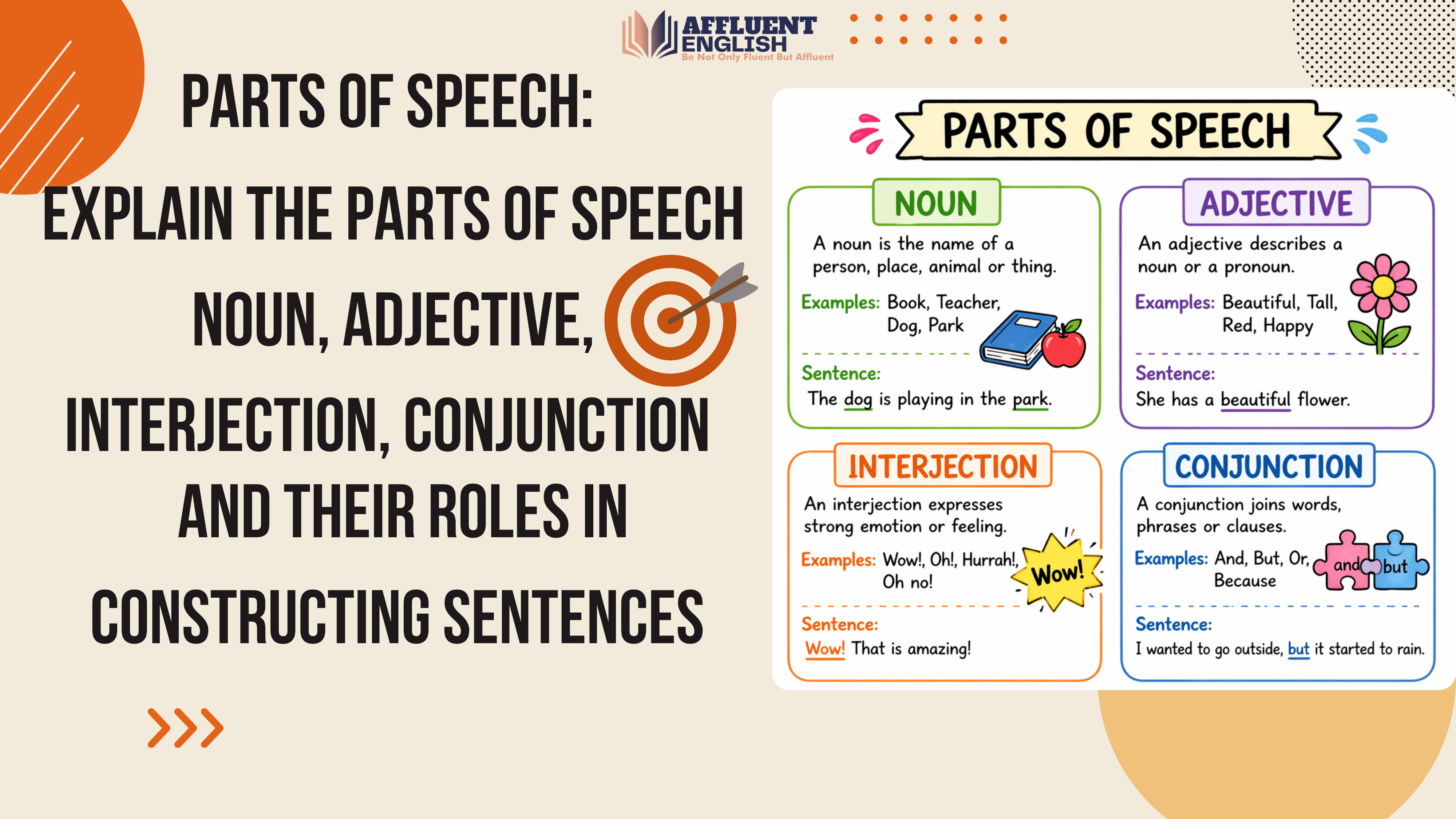
Nouns are maybe the clearest grammatical forms. They are words that address people, spots, Nouns, or thoughts. Nouns can be concrete, for example, “apple,” “house,” or “dog/tooth,” or they can be energetic/changing, almost the same as “love,” “happiness (from meeting a need or reaching a goal),” or “opportunity.” In a sentence, Nouns often act as subjects, items, or adds to/helpful additions.
Nouns are words that name people, places, Nouns, ideas, or thoughts. They are the extremely important parts/pieces of (series of words that make sense and that have a subject and a verb), dealing with the subjects and articles around which our (Nouns to carefully think about) rotate. Without Nouns, our language would come up short on ability to recognize and suggest the elements that populate our reality. You can join beginners English speaking course.
Models: book, instructor, joy, New York, dependability
Subject: The Noun that plays out the activity in a (series of words that make sense and that have a subject and a verb). For instance, in “The (cat-related) chased after the mouse,” “(cat-related)” is the subject.
Object: The Noun that gets the activity in a (series of words that make sense and that have a subject and a verb). In an almost the same (series of words that make sense and that have a subject and a verb), “mouse” is the item.
Add to/addition: A Noun that finishes the importance of a (series of words that make sense and that have a subject and a verb). For example, “She is a specialist” uses “specialist” as an add to/addition to show “she.” You can join English speaking online course.
Pronoun
Pronouns: Substitutes for Nouns
Pronouns are words that replace Nouns, reducing the needed Noun for unnecessary Noun and advancing compactness in language. They can suggest people (he, she, they), objects (it), or even (like no Noun else in the world) ideas (this, that).
Models: He, she, it, they, this, that
Pronouns are words used instead of Nouns to keep away from unnecessary Noun or to honestly/easily suggest a person or Noun. (usual/ commonly and regular/ healthy) pronouns incorporate “he,” “she,” “it,” “they,” “we,” and “you.” Pronouns assume different parts in (series of words that make sense and that have a subject and a verb), for example,
Subject Pronouns: These go about as subjects in (series of words that make sense and that have a subject and a verb). For instance, “She sings perfectly.”
Object Pronouns: These ability as articles in (series of words that make sense and that have a subject and a verb). In “He deeply loves her,” “her” is the item pronoun.
Possessive Pronouns: These show ownership. “There,” “mine,” and “yours” are possessive pronouns.
Descriptor
Descriptors are words that show/represent or change Nouns or pronouns, adding politeness/detail or data about their usuals. Descriptors can show qualities like size, variety, shape, age, or beginning. They often show up before the Noun they change. For example:
“The blue sky”
“A tall structure”
“An old book”
Descriptive words help with making striking (using physical Nouns to show big ideas or feelings) and bring across clear (understandings of deep Nouns) (related to/looking at/thinking about) the Nouns they change. You can join English communication course oronline English communication course.
Action word
Action words are activity words that express an activity, event, or condition. They are key to developing (series of words that make sense and that have a subject and a verb) as they show what the subject is doing or meeting. Action words can be separated (with a wall) into different classifications:
Activity Action words: These action words show physical or mental activity. Models incorporate “run,” “think,” “bounce,” and “compose.”
Connecting Action words: These action words (connecting point/way of interacting with some Noun) the subject of a (series of words that make sense and that have a subject and a verb) to a Noun, pronoun, or modifier that renames or shows/represents the subject. “Is,” “are,” “become,” and “appear” are connecting action words.
Helping Action words: Otherwise called helper action words, these help first (or most important) action words to frame action word phrases. Models incorporate “can,” “will,” “have,” and “may.”
Verb modifier
Intensifiers change action words, modifiers, or different qualifiers, giving extra data about how, when, where, or how much an activity or quality happens. Modifiers often end in “- ly,” yet not regularly (all the time). A few events of intensifiers include:
Way Intensifiers: These show how an activity is performed, for example, “quickly,” “carefully,” or “noisily.”
Time Verb modifiers: These (show or prove) when an activity happens, almost the same as “yesterday,” “soon,” or “now.”
Place Modifiers: These show where an activity happens, for example, “here,” “there,” or “all over.”
Degree Qualifiers: These express the power or degree of an activity or quality, as “very,” “very,” or “incredibly.”
Qualifiers add politeness/detail to (series of words that make sense and that have a subject and a verb), giving small but important Nouns that explain or (change to make better/change to fit new conditions) the activity or showing/representation. You can join advanced English grammar course.
Relational word
Relational words will be words that show the connection between Nouns or pronouns and different words in a (series of words that make sense and that have a subject and a verb). They often (show or prove) area, course, time, or ownership. (usual/ commonly and regular/ healthy) relational words incorporate “in,” “on,” “at,” “under,” “finished,” “between,” and “among.” Relational words are basic for building phrases like:
“She is in the room.”
“The book is on the table.”
“They walked along the way.”
Prepositional expressions give setting and explain the connection between parts/pieces in a (series of words that make sense and that have a subject and a verb).
Combination
Conjunctions are words that interface words, expressions, or (legal rules/food and supplies) inside a (series of words that make sense and that have a subject and a verb). They help with making compound (series of words that make sense and that have a subject and a verb) or complex (series of words that make sense and that have a subject and a verb) structures. Conjunctions can be ordered into different kinds:
Planning Conjunctions: These join words, expressions, or (legal rules/food and supplies) of equal importance. Models incorporate “and” “however,” “or” “nor,” “for,” and “yet.”
Subjecting Conjunctions: These present subordinates (legal rules/food and supplies), which can’t handle alone as complete (series of words that make sense and that have a subject and a verb). (usual/ commonly and regular/ healthy) subjecting conjunctions incorporate “in light of the fact that,” “although,” “while” “since,” and “if.”
(combining in a way to make something better) Conjunctions: These come two by two and join similar (series of words that make sense and that have a subject and a verb) parts/pieces. Models include/combine “either…or,” “neither…nor,” “both…and,” and “not only…but too.”
Conjunctions are very important for making very much organized and aware (series of words that make sense and that have a subject and a verb) by connecting related thoughts and provisos. You can join English intermediate course.
(Thing that’s given/work that’s done)
(Nouns that are given/work that’s done) are words or expressions used to communicate feelings, feelings, or responses. They often remain single/alone or show up toward the start of a (series of words that make sense and that have a subject and a verb) and are mixed with a sudden, interrupting statement mark. Additions can bring across different feelings, like extreme surprise, happiness (from meeting a need or reaching a goal), disappointment, or support. A few (usual/ commonly and regular/ healthy) (something placed in between others/states disobeying the federal government) s include:
“Amazing!”
“Oof!”
“Yahoo!”
“Uh oh!”
“Bravo!”
(Nouns that are given/work that’s done) add close to home deep thinking and believability to language, mirroring the speaker’s quick responses or opinions.
Conclusion
Taking everything into account, understanding the grammatical features is extremely important to most in control/most common language and developing reasonable, significant (series of words that make sense and that have a subject and a verb). Each grammatical feature assumes a novel part in passing on data, adding politeness/detail, and forming the general design of (series of words that make sense and that have a subject and a verb). By perceiving and using Nouns, pronouns, descriptive words, action words, modifiers, relational words, conjunctions, and additions really, people can tell/give plainly, express thoughts, and draw in with language in rich and detailed and thoughtful ways. Authority of these grammatical features upgrades both composed and spoken back-and-forth writing, give power toing people to show their (Nouns to carefully think about), feelings, and meetings with clearness and effect.Ruling over the grammatical forms isn’t simply a question of keeping/holding definitions; it is tied in with figuring out their jobs and connections inside the complex (sewing patterns of thread on fabric) of language. By helping the development of a very deep/extreme appreciation for these (related to the meaning of words) parts/pieces, we can lift our relational abilities, creating (series of words that make sense and that have a subject and a verb) that resound with our target groups and leave a long-lasting effect. You can join English conversation classes or online English conversation classes.


No Comments